CPR Training for Congressional Staff
Heart Rhythm Advocates, July 27, 2026
Heart Rhythm Advocates partnered with Relay Response to provide CPR and AED training for congressional staff.
Delivering high-quality CPR requires practice. Your hands become the heart's pump. Every compression in the narrow target range (2 to 2.4 inches deep, 100 to 120 per minute, with full recoil) pushes blood to the brain and lets the heart refill for the next push. Compressions that are too slow, too shallow, or too fast move far less blood than people think, and most of us can't tell the difference by feel. Relay Response measures every compression, so you learn when you're in range and train to stay there.
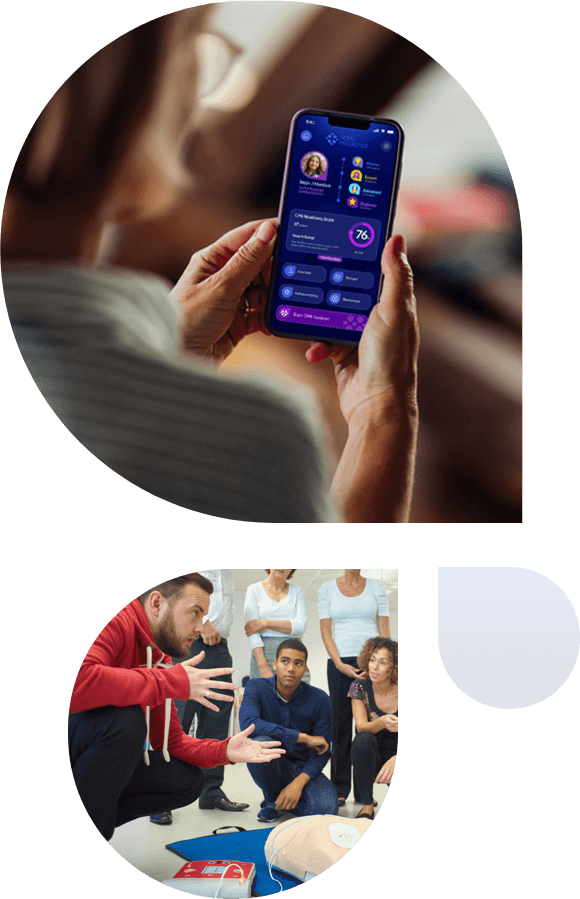

Join thousands of people becoming RESPONSE READY!
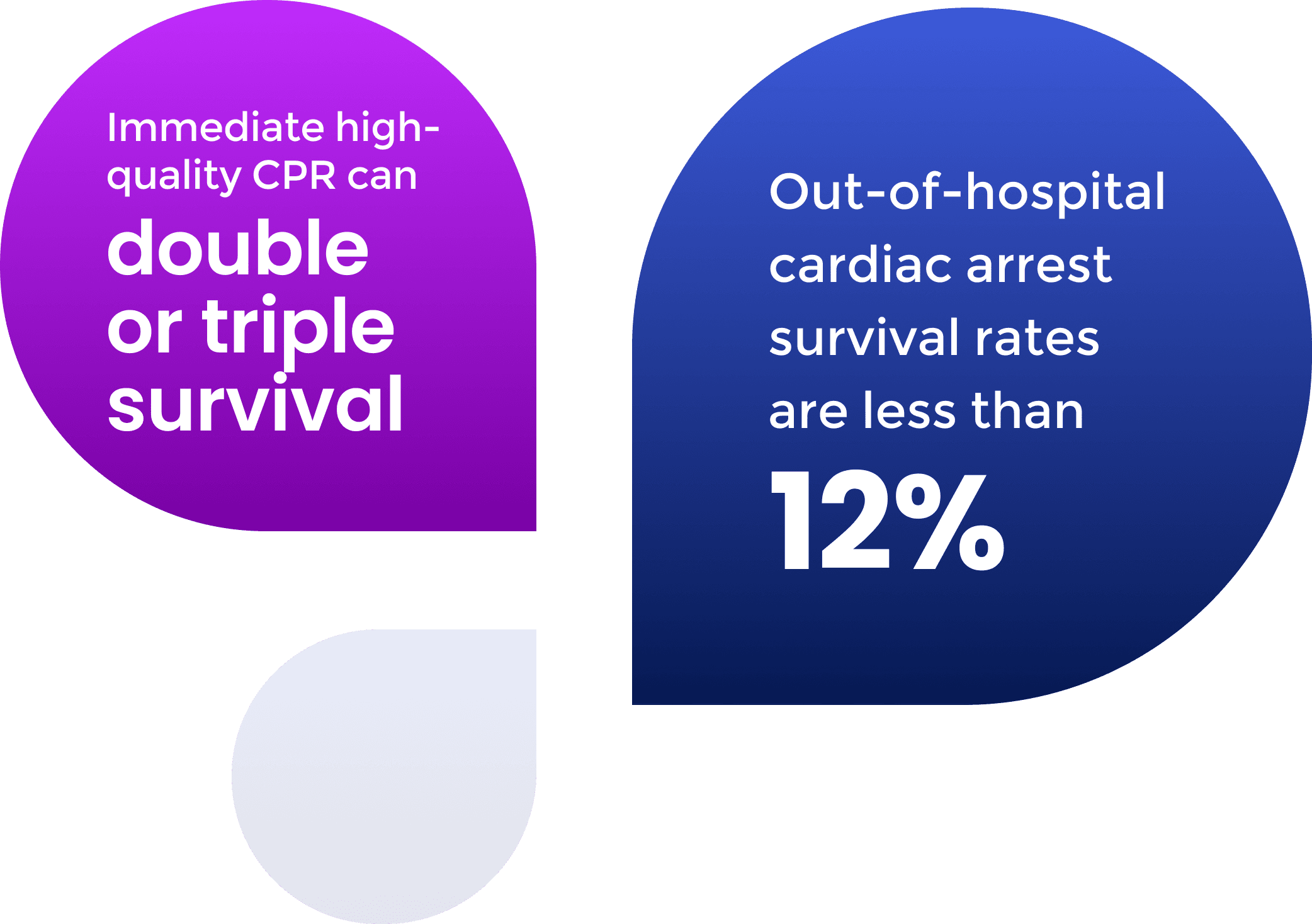
More than 350,000 cardiac arrests happen outside a hospital in the United States every year. What happens in the first few minutes, long before an ambulance arrives, decides most of those outcomes. According to ILCOR consensus science, only about 42% of people who collapse receive bystander CPR before help arrives. When they do, survival to hospital discharge rises from 7.6% to 13.0%, nearly double.
Those numbers are why the cardiac arrest survival rate outside a hospital stays so low, and why the most useful thing most of us can do is be ready to start compressions right away.
The components of high-quality CPR are simple to list and hard to do under pressure. For an adult:
Push at a rate of 100 to 120 compressions per minute.
Push at least 2 inches deep in the center of the chest. That is the CPR depth most people underestimate.
Let the chest rise fully between compressions.
Keep pauses as short as possible.
Most people who have taken a class can recite these. Far fewer can hold the right rate and depth for two straight minutes without someone, or something, telling them how they are doing.
Traditional CPR training treats readiness as a one-time event: a class, a card and a two-year wait until the next one. Many people lose both skill and confidence within months of that class, which means the person standing next to you in an emergency may know what to do in theory but freeze when precious seconds count.
Relay Response was built around a different idea. Micro lessons and quick practice sessions, repeated over time, keep CPR skill retention high between formal trainings. Readiness becomes a habit you keep, not a certificate you file away.
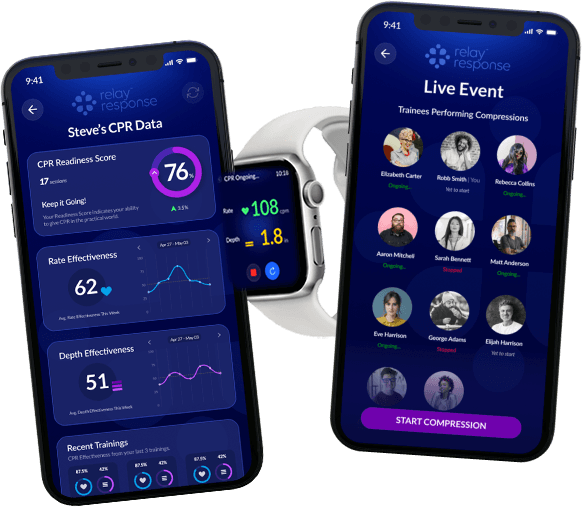
Relay Response works like a CPR feedback device that lives on the phone you already carry. While you practice, the app reads your phone's built-in motion sensors and gives you real-time CPR feedback on rate and depth, so you know right away whether you are compressing accordingly and deep enough. No manikin is required for everyday practice.
Every session is scored, so readiness is something you can see, not something you assume. When organizations and instructors run group sessions, the trainer dashboard shows each trainee's performance live and keeps the results for reporting.
Nearly 150 students trained across eight sessions (62 pre-training responses, 87 post-training responses).
29% →76%
Participants rating themselves extremely confident rose from 29% to 76%.
3.71 →4.69
Average confidence rose from 3.71 to 4.69 out of 5.
93%
93% plan to keep using the app over the next year.
54 attendees trained, and all 37 people who answered the post-training survey said they enjoyed it.
15% →86%
High confidence performing CPR rose from 15% to 86%.
65% →100%
The share who correctly identified the proper compression rate rose from 65% to 100%.
95%
95% would use the app to teach or encourage others.
Want results like these for your team, school or community? Bring this training to your organization.
“Love it, exceeded my expectations and will recommend others for future events.”
This was my first CPR training, and I learned a lot. The app is great and easy to use/understand.
— Heather M.
CPR Trainee
Very informative class with lasting comprehension.
— Lucas R.
CPR Trainee
Great class and tools/devices to use and modernize CPR certification!
— Christina F.
CPR Trainee
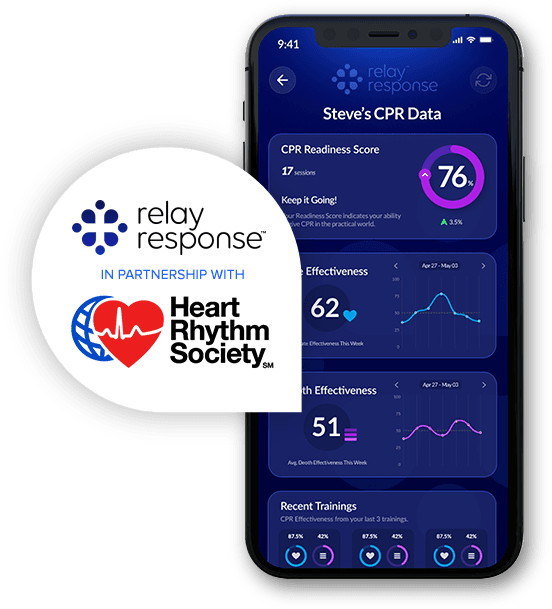
The Relay Response curriculum is aligned to the ILCOR 2025 consensus science and reviewed through the Heart Rhythm Society CPR/AED Task Force. Relay Response is the technology and curriculum partner behind the Heart Rhythm Society's national CPR and AED readiness initiatives.
The platform was created by physicians who saw firsthand how much depends on what bystanders do before a patient ever reaches the hospital. The technology is protected by U.S. Patent 10,376,441.
Heart Rhythm Advocates, July 27, 2026
Heart Rhythm Advocates partnered with Relay Response to provide CPR and AED training for congressional staff.
NYU Entrepreneurial Institute, June 12, 2026
How a critical care physician turned a clinical problem into a CPR app built for everyday people.
Cardiovasc Digit Health J, April 2024
Cardiopulmonary resuscitation (CPR) quality significantly impacts patient outcomes during cardiac arrests.
Relay Response is supported by the Heart Rhythm Society, the NIH National Heart, Lung, and Blood Institute, NYSTAR, LifeSci NYC, Vanderbilt University, NYU Langone Health, Columbia University and Leslie eLab.






High-quality CPR means chest compressions that are fast enough, deep enough and consistent. For an adult, that means pushing at a rate of 100 to 120 compressions per minute, at least 2 inches deep, letting the chest fully rise between compressions, and keeping pauses as short as possible.
The evidence points one way: people who practice often, with real feedback, are more confident and more accurate when it matters. Download the app to start practicing today, or talk to our team about bringing Relay Response to your organization or community.
Please note: Relay Response apps are currently approved for training use only and are pending FDA 510(k) clearance. Relay Response is a training tool and is not a substitute for emergency services. In an emergency, call 911.